Thomas did it too
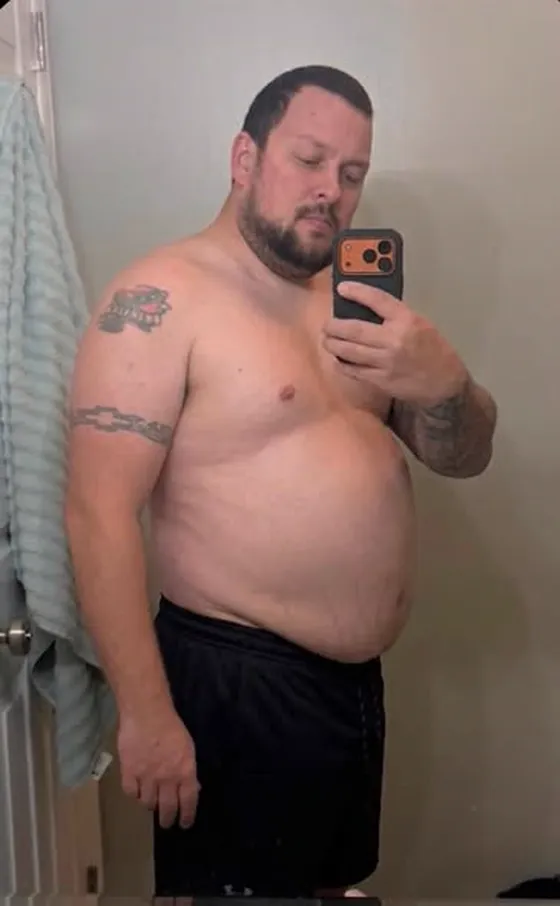

Thomas — 50 lbs down in four and a half months using DYMA.
 DYMA FIT
Track. Grind. Shine.
Your body changes every week. Your macros should too.

Backed by science ◆ Driven by your body's data
Real results


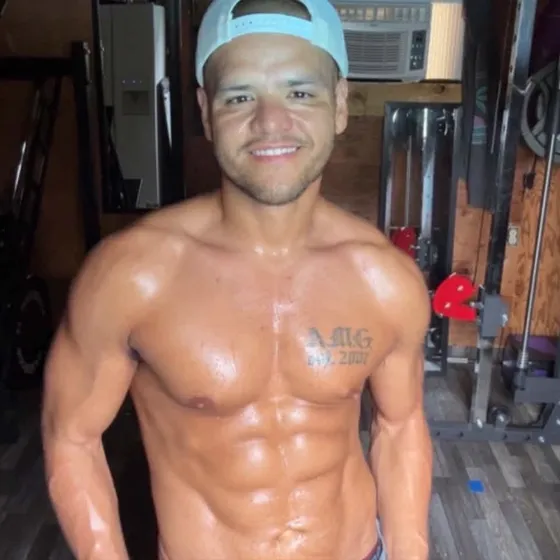
“Same man, different habits. No crash diet, no shortcuts.”
Gino Giuliano, founder of DYMA Fit — his own results over eight months, following the plan the app builds.
Thomas did it too
Thomas — 50 lbs down in four and a half months using DYMA.
Jen did it too


Jen — 55 lbs down in seven months using DYMA.
Caleb did it too
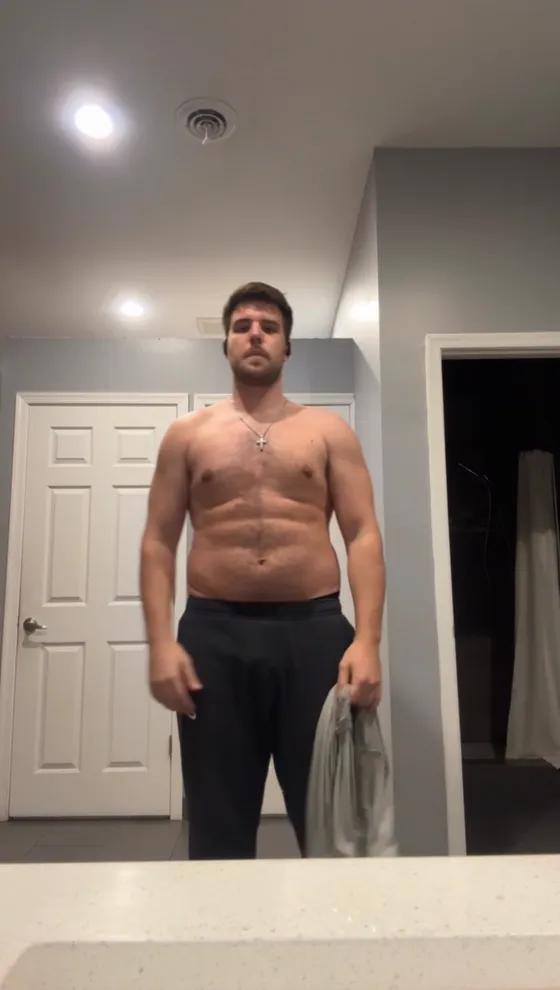

Caleb — 40 lbs down using DYMA.
Swipe for more →
None of them guessed their way there. Here's the math ↓
Where the numbers come from
The whole app rests on one sentence a ten-year-old can follow — and then does the hard work of measuring it properly, using published equations instead of guesses.
Every fitness app knows this. The hard part is measuring the two sides accurately for your body — and re-measuring them as your body changes. That's the part DYMA actually does. Here's exactly how.
Before DYMA can set you a single target, it has to answer one question: how much fuel does this body need? It builds that up in three steps.
BMR = 10·weightkg + 6.25·heightcm − 5·age + s
Lying still all day, your body still spends energy keeping you alive — heart, lungs, brain, warmth. That baseline is your BMR, and it comes straight from your sex, age, height and weight. This is the same equation clinical dietitians use.[1]
TDEE = BMR × activity
A nurse on her feet all shift burns more than someone at a desk. So the baseline gets multiplied — from 1.20 for a desk job up to 1.90 for manual labour. The result is the number you'd eat to stay exactly the same forever.[4]
target = TDEE × goal
Losing means eating a set percentage under that number; gaining means going over. Cutting is 0.80 — twenty percent below what you burn. Nothing more mysterious than that.
protein = weightlb × k · fat = (target × f) ÷ 9 · carbs = remainder
Protein is set by your bodyweight because that's what protects muscle while you lose. Fat takes a fixed share of your calories. Carbs get whatever is left, so the numbers always add back up to your target.[2]
Table 1 — the four steps run on a real profile: male, 34, 5'10", 250 lb, on his feet most days, cutting
Notice his protein came out at 245 g, not the 250 g his bodyweight asks for. That's one of the limits in §4 doing its job — protein isn't allowed to eat more than its share of the calorie budget, so the plan stays possible to actually eat.
So far: DYMA knows what he should eat. Now it has to measure what he actually did.
Your target is only half the story. The other half is what really happened today — and it arrives from three separate places.
baseline = BMR × activity × day elapsed
You don't burn a whole day's energy at breakfast. It builds through the day, so at 9am your burn shows a morning's worth — not tomorrow's promise.
workout = MET × weightkg × hours
Every exercise gets an intensity score from a published catalogue of hundreds of activities, then scales to your size and how long you went.[3]
steps = (steps − 2,000) × 0.04 × (weightlb ÷ 160)
Steps count too — but only the ones above a baseline, and scaled to your bodyweight, because a 220 lb frame spends more per step than a 130 lb one.
What's a MET? Just how hard something is compared with sitting still. Sitting is 1. Walking is 3.5 — three and a half times harder. Running is 9.8. It's a scale researchers built by measuring real oxygen use across hundreds of activities, so “how many calories was that workout” stops being a guess.
Now the bit almost every app gets wrong. Look again at EQ. 7 — why subtract 2,000 steps? Because your everyday walking is already counted back in EQ. 2, inside your activity multiplier. Count those steps a second time and you've paid yourself twice for the same walk. Do that daily and you'll “earn” hundreds of calories that never existed, eat them back, and wonder why the scale won't move. DYMA strips out the overlap before a single step is credited.
Fig. 1 — the same man's day: 45 minutes lifting, 8,400 steps
That last line is the one the app grades you on. Not a step count, not a streak — the gap between what went in and what went out, updated through the day.
Here's the catch that ruins most plans. Look back at EQ. 1: your weight is an input. A smaller body burns less — so the moment you succeed, the numbers that got you there are out of date.
Table 2 — the same man, 60 lb down over a year
| As he shrinks | 250 lb | 220 lb | 190 lb |
|---|---|---|---|
| Resting burn | 2,080 | 1,944 | 1,808 |
| Daily burn | 3,224 | 3,013 | 2,803 |
| Should eat | 2,579 | 2,410 | 2,242 |
| Protein | 245 | 220 | 190 g |
| Fat | 75 | 67 | 62 g |
His target drops 337 calories a day — a whole meal — and his protein falls by 55 g. None of that is a setting anyone changed. It's the same seven equations, fed a smaller body.
Here's what it costs to ignore. At 190 lb he now burns 2,803 a day, so his real target is 2,242 — a 561-calorie deficit. Still eating his day-one 2,579? That's a deficit of just 224. The engine driving his fat loss shrank by 60% and nothing told him. He'd still believe he was cutting, while eating within 224 calories of maintenance — and he'd blame himself when the scale stopped moving.
That's the plateau almost everyone hits, and it isn't willpower — it's arithmetic. A calculator you used once still says 2,579. DYMA says 2,242, because it runs all seven equations again every time you step on the scale. That is the entire difference between a plan and a printout.
Left alone, an equation will happily hand you a number no human should eat. These are the hard limits it isn't allowed to cross, whatever goal you set.
Nothing above is our invention. Every equation traces to one of these, and they're linked inside the app too — right next to the numbers they produce.
DYMA gives general fitness guidance, not medical advice, and is not a medical device. Talk to a healthcare professional before making major changes to your diet or exercise.
See it in action
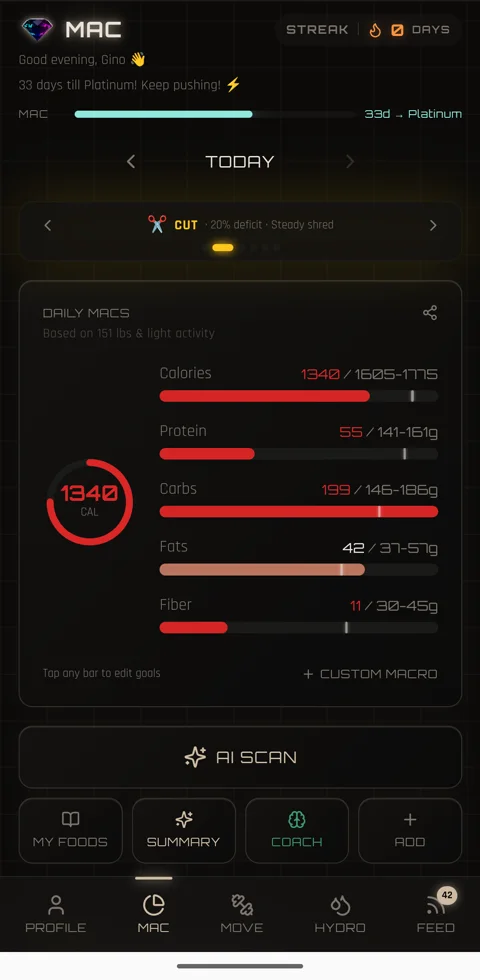
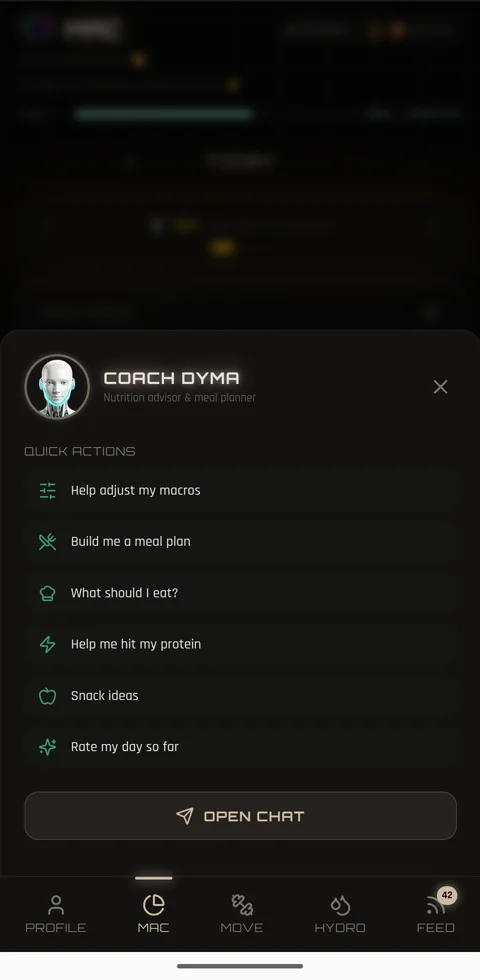
A coach in your pocket
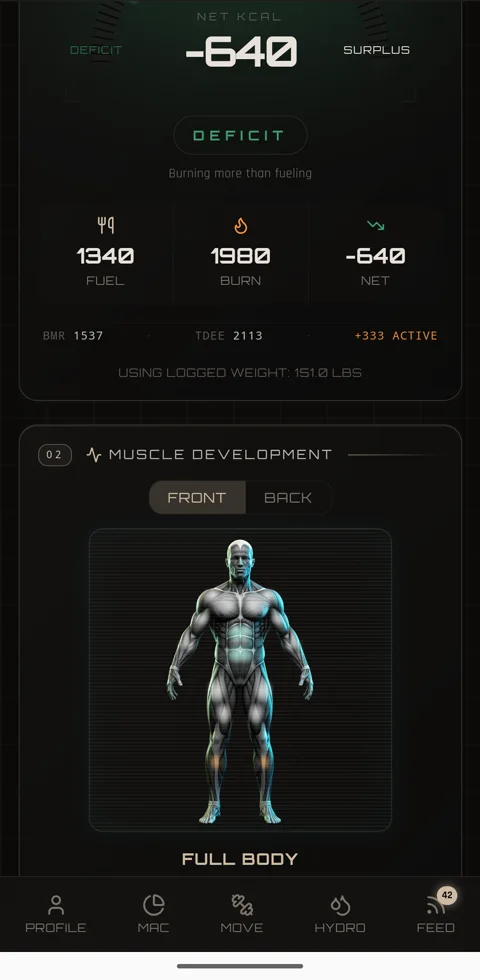
Body IQ, scored daily
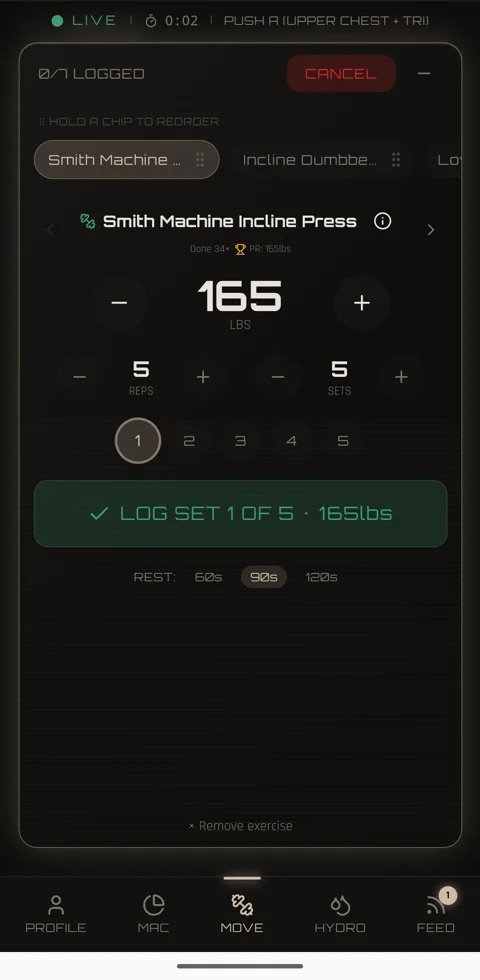
Live workout tracking
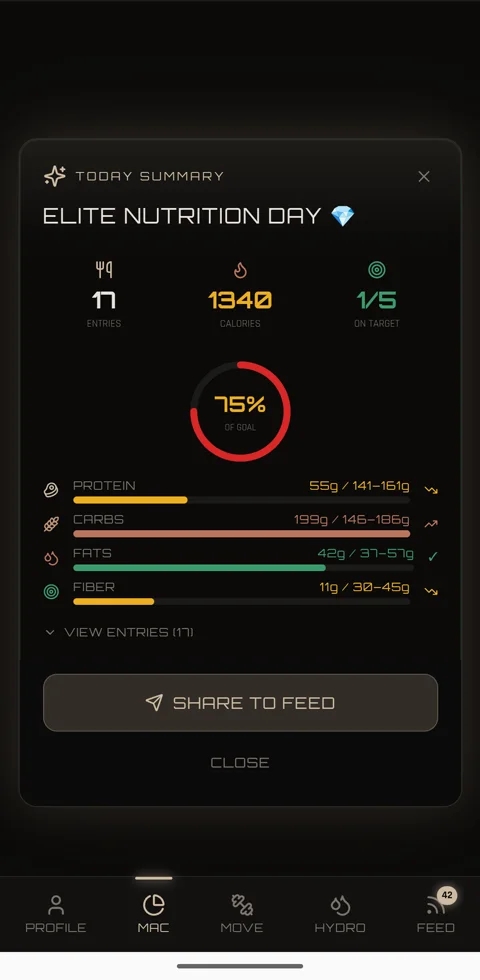
Your whole day, summed
Swipe →
The difference
You lose 8 pounds and your calorie target never notices. DYMA's engine reads your progress and rewrites the plan.
Weigh-ins, workouts, steps and intake feed one engine — not five disconnected screens.
Calories, protein, carbs, fat and fiber recalculate when your data says they should.
Past days stay locked to the targets you actually had. Your streaks never get rewritten.
Coach Dyma
Not a chatbot bolted on the side — it can log your food, build your split, and move your macros.
Straight answers
The app is free to download and set up, and your first 7 days of DYMA Premium are free — Coach Dyma, adaptive macros, workouts and Body IQ. After the trial it's $19.99/month, or $119.99/year — that works out to about $10 a month, roughly half the monthly price. Cancel any time from your Apple ID settings.
A normal tracker gives you one target on day one and leaves it there. DYMA's macro engine recalculates from your real progress — your weight trend, your training load, your goal — so the number in front of you is current.
No. Tell it what you have — full gym, a couple dumbbells, or nothing at all — and it builds around that.
Android is invite only right now — the build is finished and we're releasing invites in batches. Tap Google Play — Invite only above, leave the Google account you'd install with, and we'll send yours.
Download the app and sign in with the same email and password. Everything you've logged is waiting.
Start today
Set up in about three minutes.